Executive Summary
An Intelligent Decision Engine (IDE) is an AI-powered system that continuously integrates all of a company's data sources—operations, finance, customers, supply chain, HR, market trends, and internal documents—to learn patterns and recommend or automate optimal decisions at every organizational level, from strategic planning to daily operations.
Core Value Proposition: Enable businesses to make better decisions faster than their competitors through comprehensive data integration, AI-powered analysis, and actionable insights.
🎯 Core Concept
Traditional business intelligence tools provide insights. The Intelligent Decision Engine goes further by providing actionable recommendations that can be automated or executed with management oversight.
The IDE transforms data into decisions by:
- Ingesting data from fragmented silos across the organization
- Structuring it using AI models (LLMs fine-tuned on internal corpora)
- Learning patterns and relationships through continuous analysis
- Recommending optimal actions with transparent reasoning
- Automating approved decisions with feedback loops
🧩 Key Capabilities
1. Data Unity and Context Awareness
The Problem: Most businesses suffer from severe data fragmentation—finance uses one system, operations another, HR a third, with marketing data scattered across multiple platforms.
The IDE Solution:
- Ingests data from all organizational silos
- Structures disparate data using AI models (LLMs fine-tuned on internal corpora)
- Maintains a comprehensive "knowledge graph" of the organization
- Understands relationships between departments, processes, and outcomes
- Provides unified context that reveals patterns invisible in isolated datasets
2. Actionable Insights → Automated Execution
Traditional BI Dashboard:
"Sales are down 8% in region X."
Intelligent Decision Engine:
"Sales in region X are down because customer turnover in key accounts rose 12%, attributed to delayed deliveries and competitive pricing pressure.
Recommended Actions:
- Deploy targeted retention offers to accounts showing churn signals (estimated recovery: 40%)
- Shift 5% of marketing spend from brand to direct response campaigns
- Expedite logistics routing to region X (cost: $12K, projected revenue impact: $180K)
- Alert account managers of at-risk clients with prepared retention scripts
Confidence: 87% | Expected ROI: 15:1 | Implementation: Automated with approval"
3. Augmented Decision Making
The IDE supports managers, not replaces them, by providing:
- Transparent Explanations: Every recommendation includes the reasoning, data sources, and confidence levels
- What-If Simulations: "What if we adjust inventory by 10%?" "What if we expand into market Y?"
- Predicted Outcomes: Forward-looking projections with confidence ranges
- Risk Assessment: Identification of potential downsides and mitigation strategies
- Alternative Options: Multiple courses of action ranked by expected outcome
Managers maintain control while gaining superhuman analytical capabilities.
4. Full Offline / Intranet Capability
A critical differentiator for enterprises concerned about data security:
- On-Premises Deployment: Fully hosted inside the corporate network
- Zero External Dependencies: No cloud services required (see: Defensive IT principles)
- Internal Data Only: Uses only corporate data, ensuring compliance and confidentiality
- Same Decision Models: Identical AI capabilities as cloud versions
- Air-Gapped Option: Can operate completely disconnected from the internet
- Regulatory Compliance: Meets requirements for healthcare, finance, defense, and other regulated industries
5. Continuous Learning Loop
The system improves itself over time:
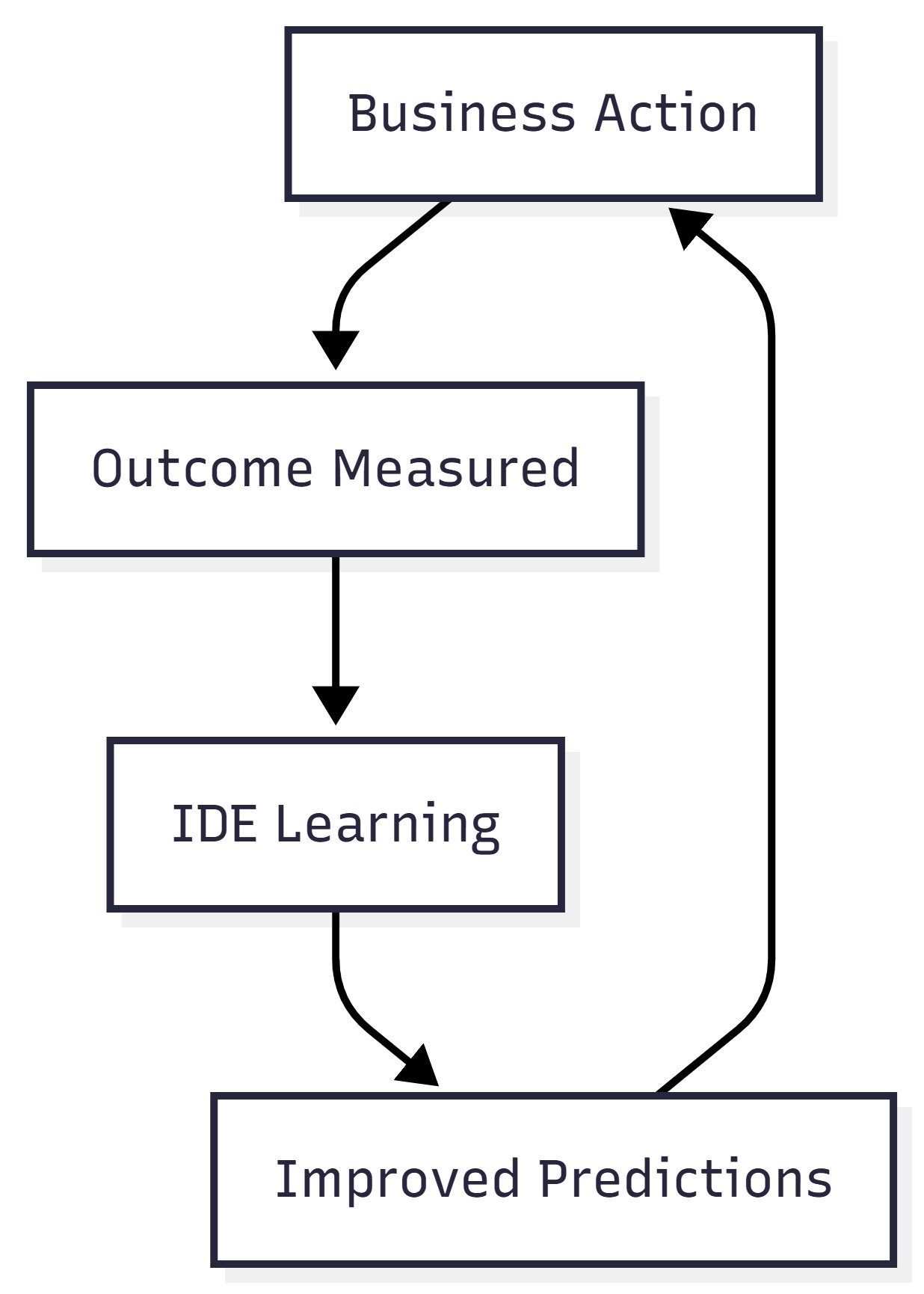
The IDE operates as a self-improving system where:
- Every business action executed and its result feeds back into the system
- Models continuously refine predictions based on actual outcomes
- Pattern recognition improves as more decisions are made
- The organization builds institutional knowledge that doesn't leave with employees
- Historical performance informs future recommendations
This creates a virtuous cycle where the IDE becomes more valuable over time, learning from both successes and failures to provide increasingly accurate recommendations.
💼 Real-World Outcomes by Role
CFO: Financial Intelligence
Receives:
- Rolling financial forecasts updated every hour
- Predictive cash flow analysis with scenario modeling
- Automated variance explanations ("Revenue exceeded forecast due to...")
- Early warning signals for budget overruns
- Real-time margin analysis across products/regions
Supply Chain Director: Predictive Operations
Receives:
- Predictive procurement recommendations that minimize cost and risk
- Inventory optimization suggestions based on demand patterns
- Supplier performance alerts with alternative sourcing options
- Logistics routing optimization
- Automated reorder triggers with smart timing
Customer Support Lead: Proactive Service
Receives:
- AI-generated issue clusters revealing systemic problems
- Predictive ticket volume forecasts for resource planning
- Root cause analysis for recurring complaints
- Suggested knowledge base articles to reduce ticket volume
- Customer satisfaction risk alerts before escalation
CEO: Strategic Dashboard
Receives:
- Executive summary explaining why metrics are moving
- Strategic opportunity identification based on market + internal data
- Competitive position analysis with recommended actions
- Risk dashboard with mitigation strategies
- Board presentation materials auto-generated with insights
HR Director: People Analytics
Receives:
- Attrition risk predictions with retention recommendations
- Recruitment pipeline optimization suggestions
- Compensation analysis with market benchmarking
- Training need identification based on performance gaps
- Organizational health indicators
🏗️ System Architecture
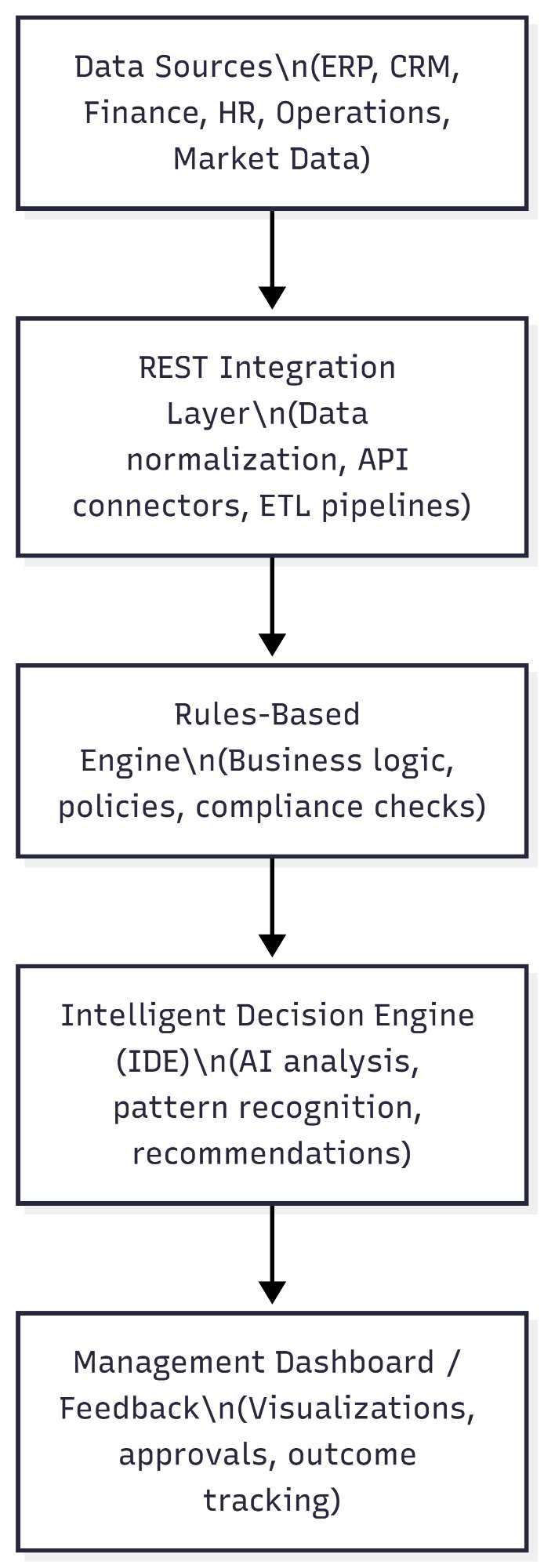
Integration Pattern (5 Layers)
The IDE integrates seamlessly into existing business infrastructure through a layered architecture:
Layer 1: Data Sources
- All operational systems feed data continuously (ERP, CRM, Finance, HR, Operations, Market Data)
- Structured (databases) and unstructured (documents, emails) data
- Real-time streams and batch imports
Layer 2: REST Integration Layer
- Normalizes data formats across disparate systems (Data normalization, API connectors, ETL pipelines)
- Provides unified API access to all data sources
- Handles authentication, rate limiting, and error recovery
- Maintains data lineage and audit trails
Layer 3: Rules-Based Engine
- Applies business rules, policies, and compliance requirements (Business logic, policies, compliance checks)
- Determines when to consult the IDE: "If existing rules don't match scenario → request IDE evaluation"
- Provides guardrails and constraints for AI recommendations
- Enforces approval workflows for high-impact decisions
Layer 4: Intelligent Decision Engine (IDE)
- Analyzes historical data, current trends, and external signals (AI analysis, pattern recognition, recommendations)
- Identifies patterns invisible to rule-based logic
- Generates recommendations with confidence levels
- Learns from outcomes to improve future decisions
- Handles ambiguous or unprecedented situations
Layer 5: Management Dashboard / Feedback
- Presents recommendations in business-friendly format (Visualizations, approvals, outcome tracking)
- Enables approval workflows for automated actions
- Captures outcome data for continuous learning
- Provides transparency into AI reasoning
- Delivers role-specific views and alerts
Decision Flow Example
Scenario: Inventory level drops below threshold
1. Data Source: Inventory system triggers alert
2. REST Layer: Normalizes data, checks for related signals (sales velocity, supplier lead times)
3. Rules Engine: Applies reorder policy → finds scenario doesn't match standard rules (supplier disruption)
4. IDE Consulted: Analyzes alternative suppliers, pricing trends, cash flow impact
5. IDE Recommends: "Order from Supplier B (15% higher cost but 3-day delivery vs. 3-week),
                     estimated revenue loss from stockout: $450K vs. extra cost: $22K"
6. Dashboard: Presents recommendation to Supply Chain Director with one-click approval
7. Feedback: Actual outcome (delivery time, cost, sales) fed back to IDE for learning
🚀 Why This is Transformative
Competitive Advantage Through Decision Velocity
Traditional Business:
- Analysis takes days/weeks
- Relies on human pattern recognition (limited by cognitive capacity)
- Decisions made with incomplete information
- Learning from outcomes is informal and scattered
- Key insights trapped in individual minds
Business with IDE:
- Analysis available in seconds/minutes
- AI pattern recognition across millions of data points
- Decisions made with comprehensive organizational context
- Systematic learning from every outcome
- Institutional knowledge codified and amplified
The Ultimate Business Advantage
Every business's ultimate competitive advantage lies in making better decisions faster than rivals.
A true Intelligent Decision Engine—combining AI, analytics, NLP, and private integration—delivers exactly that advantage.
🔒 Security & Compliance
Enterprise-Grade Protection
- Data Sovereignty: All data remains within corporate control
- Zero External Dependencies: No cloud services required (Defensive IT)
- Audit Trails: Complete lineage of every decision and recommendation
- Role-Based Access: Granular permissions for data and recommendations
- Compliance Built-In: Meets GDPR, HIPAA, SOC 2, and industry-specific requirements
- Explainable AI: Transparent reasoning for regulatory review
Deployment Options
- Cloud-Hosted: For organizations comfortable with SaaS
- On-Premises: Fully internal deployment
- Hybrid: Critical data on-premises, supplementary data in cloud
- Air-Gapped: Completely disconnected for maximum security
📊 Success Metrics
Quantitative KPIs
- Decision Speed: Time from signal to action (target: 90% reduction)
- Decision Quality: Outcome accuracy vs. predictions (target: >80% within confidence ranges)
- ROI: Value created vs. system cost (target: >10:1)
- Automation Rate: % of routine decisions automated (target: 60%+)
- Error Reduction: Decrease in suboptimal decisions (target: 70%+)
Qualitative Benefits
- Reduced "analysis paralysis"
- Increased manager confidence in decisions
- Better cross-functional coordination
- Faster response to market changes
- Enhanced institutional knowledge retention
🎯 Strategic Differentiation
What Makes IDE Different from Traditional BI
| Traditional BI | Intelligent Decision Engine |
|---|---|
| Shows what happened | Predicts what will happen |
| Reactive insights | Proactive recommendations |
| Requires human analysis | Provides actionable guidance |
| Static dashboards | Dynamic decision support |
| Fragmented data views | Unified organizational context |
| One-way reporting | Continuous learning loop |
| Generic insights | Role-specific recommendations |
🌐 Technology Stack
Core Components
AI/ML Layer:
- Large Language Models (LLMs) fine-tuned on internal corpora
- Predictive analytics (time series, regression, classification)
- Natural Language Processing (NLP) for document analysis
- Computer vision for visual data (optional)
Data Layer:
- Knowledge graph database (Neo4j, or equivalent)
- Time-series database for operational metrics
- Vector database for semantic search
- Traditional RDBMS for transactional data
Integration Layer:
- RESTful API framework
- Message queue for async processing
- ETL/ELT pipelines
- Real-time data streaming
Decision Layer:
- Rules engine (Drools, or custom)
- Optimization algorithms
- Simulation engine
- Recommendation engine
Presentation Layer:
- Role-based dashboards
- Mobile applications
- Alert/notification system
- Collaboration tools
🔮 Future Evolution
Advanced Capabilities (Roadmap)
- Autonomous Decision Making: Fully automated decisions for routine scenarios with human oversight for exceptions
- Multi-Agent Systems: Specialized AI agents for different business functions coordinating decisions
- Predictive Scenario Planning: Automated generation of strategic scenarios and contingency plans
- Natural Language Interface: Conversational AI for ad-hoc queries and explorations
- Causal Inference: Moving beyond correlation to understanding causation for better interventions
- Federated Learning: Learning across multiple organizations while preserving data privacy
📖 Conclusion
The Intelligent Decision Engine represents the next evolution in business management systems—moving from descriptive analytics to prescriptive intelligence, from insight generation to decision automation, and from fragmented tools to unified organizational intelligence.
By integrating all organizational data, learning continuously from outcomes, and providing transparent, actionable recommendations, the IDE enables businesses to operate at a higher level of effectiveness than ever before possible.
The future belongs to organizations that can make better decisions faster than their competitors. The Intelligent Decision Engine is how you get there.
📚 Additional Resources
- Case Studies: [Contact for enterprise implementations]
- Technical Architecture: [Detailed design documents available]
- ROI Calculator: [Estimate value for your organization]
- Demo Environment: [Request access to sandbox]
- Integration Guides: [API documentation and connectors]
🤝 Getting Started
Interested in implementing an Intelligent Decision Engine?
Contact: info@axfordai.com
Next Steps:
- Schedule an assessment call
- Data landscape analysis
- Use case identification
- Proof of concept design
- Implementation roadmap
Document Version: 2.0
Last Updated: February 2, 2026
Classification: Internal/Confidential